
A confession before the map
I’ll start with a confession. I like this sector. I like the founders, who are some of the most technically serious people I’ve met in Indian fintech this year, and I like the demos, which are now good enough that I have twice failed to notice I was talking to software. I like that the problem is real: India makes an ungodly number of phone calls, most of them placed by underpaid twenty-three-year-olds reading a script in a room in Noida, and a lot of that work should be done by a machine.
And I still haven’t written a cheque into it.
I want to explain why, because the reason isn’t the technology. What a venture investor is actually buying at Series A is not this year’s revenue; it’s the right to own a category when the category consolidates. For that to be worth owning, someone has to end up with pricing power, and I’ve spent most of this year trying to work out where in Indian voice AI pricing power could possibly sit. I keep landing on the same answer: not with the startup. That’s the argument. The rest is the evidence, the full map, and the questions I’d need answered before I changed my mind.
Here’s what got me thinking. Between the end of July and the last week of August 2026, Smallest.ai closed a $13 million Series A, Ringg AI added $10 million from Peak XV to a round it had opened in January, and Gnani.ai, which has been quietly selling speech recognition to banks since 2016, announced a Mumbai office. Nobody blinked. Indian voice AI startups raised $329 million between January and August this year, against $12.9 million in the same eight months of 2025. There are 31 companies, 20 with institutional money, 7 at Series A or beyond, and the cap tables are a roll-call: Peak XV, General Catalyst, Accel, Lightspeed, Elevation, Khosla, Stellaris, Z47, Arkam. Cumulative funding, about $449 million.
Then I did the unglamorous thing and counted customers. Not users. Not minutes. Customers who will sign a contract worth a few hundred thousand dollars a year and renew it. Banks, the larger NBFCs, brokers, insurers, a few government-adjacent utilities (FASTag, DigiYatra, the power distributors), and whichever consumer apps haven’t built it themselves. I get to about a hundred. And every one of them, as a matter of policy, keeps two to five vendors on the panel so that no vendor ever gets comfortable.
India will be one of the largest voice AI markets in the world by minutes. I don’t think it will be one of the most profitable. Both are true at once, and the second is the one that matters if you’re writing the cheque.
Gulshan Dhanani wrote a sharp version of this on his Substack last week (”The Mirage of India Voice AI Opportunity”), and I agree with most of it. What I want to add is the view from my side of the term sheet: what the human baseline does to price, why inbound and outbound are different businesses that happen to share a word, who the 85-odd companies on the map actually are, and what I’d need to see before a Series A.
This is a personal read, from a lot of conversations and no small amount of coffee. Not the house view.
Start with the woman being replaced
Every conversation about voice AI in India should begin on a call-centre floor, so let’s go there. The person the software replaces is a telecaller. In Jaipur or Indore she earns ₹9,000 to 15,000 a month. In Noida or Bengaluru, ₹15,000 to 25,000. If she’s selling credit cards for a bank, ₹16,000 to 22,000 fixed, plus incentives that on a good month double it. Her employer loads that with statutory costs, a supervisor, a seat and the cost of her leaving (30 to 50% of the floor turns over every year), then divides by the 200-odd minutes a day she actually spends talking. It comes out between ₹5 and ₹8 per connected minute. The tightest like-for-like number I’ve seen, from Gowri Shankar Nagarajan’s MarketMapMondays, is ₹5.14 for a ₹13,000-a-month caller. Inc42’s July piece on unit economics used ₹7 to 8 before hiring and training. I use ₹6.
Hold that number. It’s the ceiling on every price in this market.
Now do the same sum in America. An offshore agent serving US customers costs $6 to 15 an hour; an onshore one, several times that. A voice agent on Retell or Vapi runs $0.07 to 0.31 a minute all-in. The machine is cheaper by an order of magnitude, sometimes two, and that gap is the entire reason Sierra is valued at $15.8 billion and Decagon at $4.5 billion on roughly $200 million and $100 million of run-rate revenue. When the customer saves that much, the vendor keeps a fat slice and nobody argues.
In India the wedge is not 10x. It’s 1.5x to 3x, and only at the bottom of the curve. Bolna, the General Catalyst-backed orchestration platform, charges ₹5.5 a minute self-serve and negotiates down to ₹1.75 to 2 for enterprise volume commitments. The Filter Coffee newsletter’s figure for “voice AI at scale” is ₹2.5. Against ₹6 for a human, the buyer saves about ₹3.5 a minute, which on a million minutes a month is ₹35 to 45 lakh. Real money. Not money that changes a bank’s year.
And here’s the bit I’d underline in red if I were reading a deck. A cascaded voice agent (speech-to-text, a frontier language model, text-to-speech) costs roughly ₹4.68 a minute at list prices. Add a lean orchestration and telephony layer and you’re at ₹6.13; a full wrapper with analytics and compliance tooling runs about ₹10.3. The human is ₹5.14. A company built on rented models cannot undercut an Indian telecaller. It can match her. Matching doesn’t get you a Series B.
Two things rescue the economics, and neither belongs to the startup. Model costs fell 60 to 80% between 2024 and 2026 (Sarvam now sells streaming speech recognition at ₹30 an hour, which is ₹0.50 a minute), so a price agreed in 2024 is mostly margin today. And the government subsidises the compute that trains the next generation of Indic models at ₹65 to 67 per GPU-hour under the ₹10,372 crore IndiaAI Mission. Both push the floor down. Both are visible to the customer’s procurement team, who will ask for the floor.
Two businesses that share a word
When I ask a voice AI founder what they do, they say “voice agents.” When I ask where the revenue comes from, they usually describe an outbound business: lead qualification, EMI reminders, collections, renewals, abandoned carts, onboarding calls. That’s the natural place to start. The script is fixed, the data is last quarter’s, the customer can run a pilot without a live human ever hearing a robot, and the volumes are enormous. It’s also, if you’re looking at it as something to back for ten years, the worst corner of the market.
Consider what an outbound minute has to survive. Connect rates run 46 to 48% across a 50-million-call dataset tracked by Callyzer, and the average connected conversation lasts 1.6 minutes. Half the dials produce nothing you can bill; the other half are over in 96 seconds. Then the regulator shows up. TRAI’s February 2025 amendment cut the threshold to five complaints in ten days before a sender’s numbers get restricted, raised penalties on operators to ₹2 to 10 lakh, and pushed all business calling onto the 140 (promotional) and 1600 (transactional) number series, with BFSI entities mandated onto 1600 between January and March 2026. Caller-name display arrives this year. TRAI sent 7.31 lakh notices to unregistered telemarketers in 2025. Every one of those measures is good for you and me as citizens, and every one lowers the odds that anyone picks up a call from exactly the kind of number a voice agent calls from.
RBI adds its own layer: recovery calls only between 8 am and 7 pm, and since the May 2025 Digital Lending Directions the borrower must receive the agent’s details by SMS before the call is placed. None of this kills the machine. All of it shrinks the window, raises the compliance bill, and turns a per-minute business into a per-outcome business, where the vendor carries the risk the customer used to.
You can watch the market admit this in real time. SquadStack raised ₹140 crore from Bertelsmann in 2022 as a managed telesales network, relaunched around “Humanoid” AI agents in 2025, and in 2026 moved from per-minute to revenue-linked pricing. Caller Digital quotes ₹8 to 25 per outcome. I read outcome pricing the way I read a founder offering a free pilot: it tells me the buyer wouldn’t pay the sticker. Then look at who left. Skit.ai, once Vernacular.ai and the poster child of Indian voice AI with a $23 million WestBridge Series B in 2021, laid off 115 people in 2023 and now sells collections agents to American debt-recovery firms from a Madison Avenue address. Vodex tried India in 2022, found “low adoption,” and does US collections from Delaware. When the two most experienced outbound teams in the country both decide the best Indian outbound market is the United States, I take that as a considered opinion.
Inbound is a different animal, and the one I’d rather back. Support, KYC, servicing, appointment booking, order status: the minutes are stickier, the willingness to pay is higher because a contained call displaces a human contact Gartner prices globally at around $13.50, and the agent gets to have an actual conversation instead of 96 seconds of “is this a good time.” Ringg AI, now the best-funded pure play at $15.5 million, is the case study: 20 million call attempts a month, appointment booking across 1,200 Practo clinics, L1 and L2 support for CRED, Groww and Flipkart, and a claimed 77% of conversations finished without a human. Gnani.ai says 30 million spoken interactions a day and 200 enterprise customers, mostly banks and insurers, mostly inbound.
But I’ve learnt not to fall in love with inbound either, for three reasons. Containment is hard: Gartner found only 14% of service issues fully resolved in self-service globally, and Indian calls arrive in Hinglish, from the back of a scooter, on an 8 kHz line. The incumbents got there years ago: BPOs automated most of L1 and much of L2 with IVR and chat, and Exotel (7,000 enterprises, ₹490 crore of FY25 revenue and, for the first time, a ₹20 crore profit) owns the telephony every startup has to rent. And the biggest inbound buyers keep building it themselves. Meesho’s in-house voice bot handles 60,000 calls a day at 95% resolution and cut per-call cost by 75%. Eternal turned its support stack into Nugget and sells it to others. Swiggy went to Sarvam for voice ordering in 11 languages, not to a startup. Bajaj Finserv’s FINAI programme is the closest thing India has to an enterprise going all-in, and it works with a short list of favoured vendors, not the field.
So: outbound is where the minutes are, inbound is where the margin is, and the hundred buyers who matter treat both as procurement categories with five names on the panel. If you’ve ever sat through a bank’s annual vendor review, you know what that does to price.
The map: every company, by where the margin sits
I’ve grouped these by where they sit in the stack rather than by what the website says, because the stack position tells you the gross margin before the founder does.
Layer 1: Models and speech infrastructure. Sarvam AI is the centre of gravity: a $234 million first close of its Series B at a $1.5 billion valuation in June 2026, $150 million of it from HCLTech, and speech models that top the Voice of India benchmark on Hindi (5.0% word error rate against Deepgram Nova-3’s 13.0% and GPT-4o-transcribe’s 33.9%). Gnani.ai is the other full-stack owner: Vachana speech-to-text trained on a million hours under the IndiaAI Mission, its own TTS, a claimed gross margin above 80%, and a $10 million Series B from Aavishkaar in March 2026. Smallest.ai builds sub-100-millisecond Lightning TTS and Pulse STT ($21 million from Sierra Ventures, Seligman and 3one4; RingCentral and Truecaller as customers). Navana.ai (₹40 crore Series A led by Ronnie Screwvala this month; Bajaj Finserv, Ujjivan and Jana as clients; the 10,000-hour RESPIN dataset built with IISc) and Shunya Labs (216 languages, roughly $5.5 million raised, spun out of United We Care) are the sovereign-model challengers. Then the older guard: Reverie (owned by Jio since 2019), Mihup (Kolkata, about ₹100 crore raised), and AI4Bharat at IIT Madras, whose IndicVoices and IndicConformer models sit under half the startups in this piece. Dubverse’s team was acqui-hired by Exotel in April 2026. And the global suppliers everyone rents: ElevenLabs, Deepgram, Cartesia, OpenAI Realtime, Gemini Live.
Layer 2: Horizontal agent and orchestration platforms. Ringg AI ($15.5 million; Arkam, Peak XV, Groww Founder Fund, Kunal Shah). Bolna ($6.3 million from General Catalyst and YC; about $700,000 of ARR in January on 200,000 calls a day). Blue Machines (orchestration for financial services, live at Aditya Birla Capital). Sarvam Samvaad, Sarvam’s own agent platform, which is why roughly 80% of Sarvam’s ~$12 million ARR is agents rather than models. Smallest’s Atoms. Nurix AI (Mukesh Bansal’s $27.5 million from General Catalyst and Accel in 2024, rebranding as NuPlay and having bought Verloop.io in July 2026). Vobiz (telephony plus agents). SuperBryn ($1.2 million from Kalaari for voice-agent evaluation, the picks-and-shovels play). Below them, a long self-serve tail at ₹2 to 8 a minute: Caller Digital, DialNexa, Vomyra, Tabbly, Bolti, Vyora, HuskyVoice, OmniDimension, Tough Tongue, Awaaz.ai, Haloocom, Tring AI, Callchimp, Dvaarik, ThinnestAI, Trikon, Agni. And the global platforms Indian builders quietly run on: Vapi, Retell, Bland, LiveKit, Pipecat.
Layer 3: BFSI-vertical agents. This is where the venture money has concentrated, because it’s the only vertical with a hundred buyers. GreyLabs AI (₹85 crore Series A from Elevation in October 2025, seeded by Z47; 50+ BFSI clients including RBL Bank, AU Small Finance Bank, IDFC FIRST, SBI Life, ICICI Prudential and Piramal; the founders previously built Cogno AI, which Exotel bought in 2021). Arrowhead ($3 million from Stellaris in January 2026; 20-minute outbound sales conversations for Bank of Baroda Cards, Aditya Birla Capital and Paytm; live in Malaysia). Navana and Blue Machines straddle layers one and three. Credgenics and Spocto (Yubi) ship voice bots as features of collections platforms. CoRover’s BharatGPT runs IRCTC’s AskDISHA and NPCI’s conversational UPI.
Layer 4: Incumbents pivoting. Gnani (founded 2016). Skit.ai (2016, now US collections). SquadStack (Humanoid; outcome pricing; IndiaMART, Upstox, Kotak Securities, AngelOne). Convin ($6.5 million from India Quotient in 2024; call QA moving into agents). Yellow.ai (going public through a $550 million SPAC with Bluerock on $34 million of 2025 revenue, with a stated plan to buy BPOs and automate them). Jio Haptik. Uniphore ($260 million Series F in October 2025 at $2.5 billion, flat to 2022). Kore.ai, Rezo.ai, Floatbot, Superbot, Oriserve, Salesken. And the CPaaS and telephony layer every one of the above must rent or partner with: Exotel, Ozonetel, MyOperator, Knowlarity (Gupshup), Airtel IQ, Tanla, Route Mobile, Kaleyra, Acefone, Servetel, CallHippo, Ubona, Plivo. Each now markets an “AI voice agent.” Each already has the customer, which is the part that matters.
Layer 5: Adjacent verticals. Vahan.ai (AI recruiter; $10 million Series B from Khosla; roughly 40,000 blue-collar hires a month for Zomato, Swiggy, Zepto and Flipkart). Edysor (₹1.2 crore pre-seed; admissions calling for colleges). KissanAI (agri). Vodex (US collections). Wysa has a voice mode but is a mental-health product, not a phone agent.
The in-housers. Meesho, Eternal (Nugget), Bajaj Finserv (FINAI), Swiggy (with Sarvam). Every one of these is a buyer subtracted from the hundred.
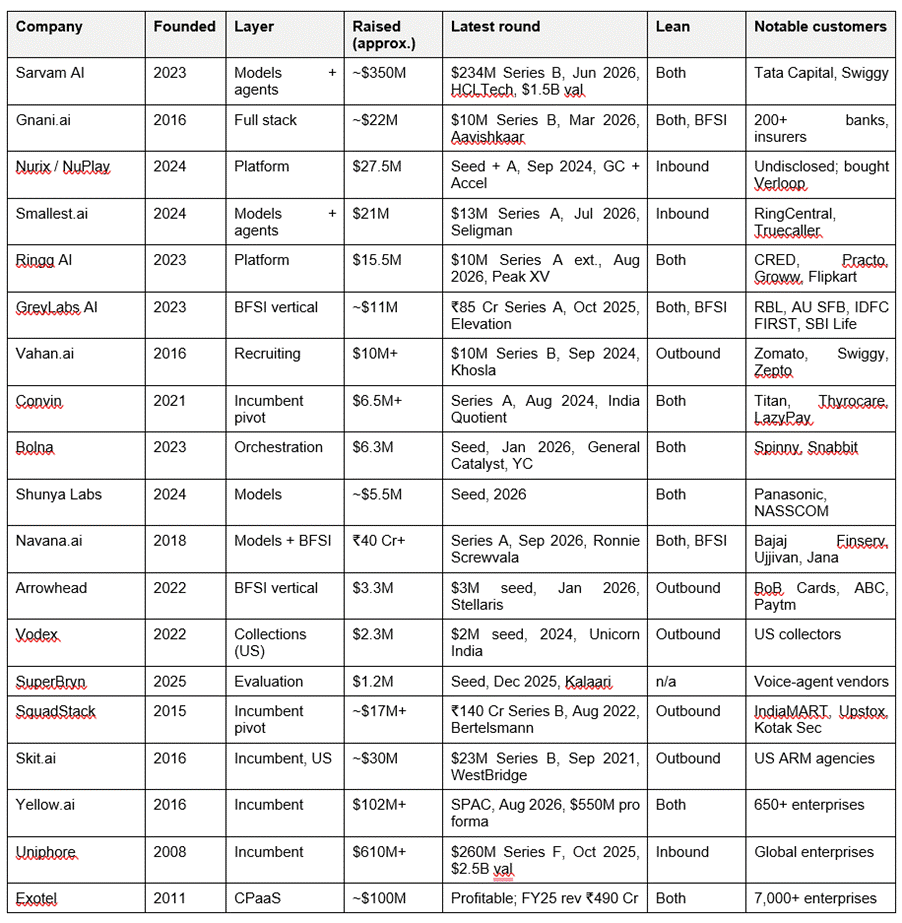
Sources: company announcements, TechCrunch, Inc42, Entrackr, Business Standard, Marketbites. Figures approximate; see notes at the end.
Five questions before the Series A
These are the questions I’d put to any company on that map. The answers are what separate a category from a feature.
1. Who is on the other side of your contract, and how many others are on the panel? Pilots run $20,000 to 30,000; a good annual contract is $100,000 to 500,000; a healthy single use case is 60,000 to 90,000 connected minutes a month. A hundred buyers at $300,000 is $30 million a year for the whole country, before it’s split five ways. Grand View sizes Indian conversational AI at about $575 million in 2025; voice is perhaps 25 to 40% of that, and the $150 to 230 million includes infrastructure, consumer and government spend. If a founder tells me the top three customers are 60% of revenue, I’m not surprised. I’d be surprised if they weren’t.
2. What happens to your gross margin when your supplier cuts price? Gnani claims 80%+ because it owns speech-to-text, text-to-speech and orchestration. A company on frontier APIs sits at cost parity with a human, and every time the model layer gets cheaper the customer wants the saving passed through. Show me the margin bridge, not the margin.
3. Who carries the outcome risk, and did you choose to? If you price per outcome, show me the connect rate, the compliance cost, and what a TRAI amendment does to both. If you price per minute, show me why the customer let you.
4. Can you go from one use case to five inside the same bank? This is the question the Series B investor will ask in eighteen months, so I ask it now. A vendor that runs collections reminders for one NBFC is a line item. A vendor that runs collections, servicing, onboarding, renewals and KYC for that NBFC, in nine languages, is the thing procurement can no longer put out to tender. Net revenue retention inside a single logo is the only growth metric in this market I trust.
5. How does this end? The consolidation Dhanani predicts in three to five years is already under way and balance sheets are leading it: HCLTech into Sarvam, Nurix buying Verloop, Exotel absorbing Cogno and then Dubverse, Yellow.ai buying BPOs, Uniphore buying Orby and Autonom8. The natural acquirers are telcos, CPaaS players, IT services majors, BPOs and, increasingly, the banks themselves. They’ll pay for customers and telephony. They won’t pay much for a demo, and they won’t pay a venture multiple for either.
What $1.5 billion buys you
Sarvam’s round is the reference price, so it deserves a hard look. At roughly $12 million of ARR (Inc42’s figure, with conversational agents close to 80% of it), $1.5 billion is about 125x revenue. Sierra changes hands at around 79x, Decagon at 45x, ElevenLabs at 22x on $500 million of ARR, Deepgram at 13x. The two India-origin companies with a public mark are less flattering: Yellow.ai’s SPAC values it at a $300 million pre-money, under 9x revenue, and Uniphore’s Series F was flat to 2022. Sarvam is being priced as a sovereign model company with an agent business attached; the agent business alone wouldn’t carry the number. HCLTech is buying an option on Indian enterprise AI distribution, which is a perfectly reasonable thing for HCLTech to buy. I’ve heard people use it as a comp for seed-stage agents. Please don’t.
The good news for anyone writing early cheques is that the application layer hasn’t run away. Strip out Sarvam and the other thirty companies have raised about $100 million between them. The largest pure-play round is Ringg’s $15.5 million. Bolna raised $6.3 million on $700,000 of ARR, which is aggressive but not absurd for a YC company doing 200,000 calls a day. Prices at seed and A are still being set by the customer list, not the narrative, and that’s how it should be.
The bull case, and I want to be fair to it because I’ve been wrong before about markets that looked structurally unprofitable: model costs keep collapsing; Indic accuracy crosses the 20% word-error usability line in Tamil and Telugu the way it already has in Hindi (the best models still sit at 14 to 19% in the southern languages); the 1600 series ends up raising pickup rates by making business calls identifiable rather than suspicious; and the hundred buyers become three hundred as mid-market NBFCs, hospital chains and broking apps arrive. In that world, the vendor that owns a bank’s collections and servicing across ten languages is a ₹500 crore revenue company, and consolidation makes it worth 8 to 10x that.
The bear case is Dhanani’s and mine: the buyer pool is fixed, the buyers are sophisticated, the human baseline is cheap, outbound is a price war regulated downward, inbound is contested by incumbents and in-housers, and the model layer is being commoditised by a national champion and a government subsidy. In that world, the equity value ends up with three or four full-stack or distribution-owning companies, and a long tail of ₹20 to 50 crore revenue businesses that never quite get to Series C.
My call: the bear case for the sector, and a selective bull case inside it. Voice AI in India is a real, large, permanent shift in how enterprises talk to customers. It’s also a market where the value created goes mostly to the buyer, the telco and the model owner, and only what’s left to the application startup. That’s a fine market in which to build a ₹100 crore profitable company. It’s a hard one in which to underwrite a fund-returning exit, unless you’re backing the specific company that will do the consolidating.
Which is where I’d look, if I were looking. The shape I’d back is a full-stack owner (its own speech model, its own turn-taking, its own telephony relationship) that has one bank on a sole-vendor contract in one use case and a credible path to four more inside the same bank. That company doesn’t need the hundred buyers. It needs ten of them, deeply. Watch, too, what Yellow.ai is doing with its SPAC proceeds: buying BPOs and rebuilding them on its own software is a tell about where the cash in this market actually lives, with whoever owns the floor and the client relationship. For a venture investor, that is the exit path written out in advance. The startup that owns a bank’s servicing in ten languages sells to whoever owns the floor.
If you’re building, or backing
The conversation I keep having with founders goes like this. They show me the demo, and it’s excellent. They show me the pipeline, and it’s the same ten banks everyone else has. Then I ask who else is in the pilot, and there’s a pause. That pause is the market.
If you’re a founder: choose inbound over outbound unless you can own the outcome and the telephony. Build for BFSI because that’s where the buyers are, but know that your customer’s procurement head has your competitor’s proposal open in the next tab. Price per outcome only if your unit economics survive a 46% connect rate. Own at least one model in the stack (turn-taking, denoising, a domain speech model) or accept that your gross margin is a rented asset. And treat pilot-to-contract conversion as the metric that matters: a $25,000 pilot that hasn’t become a $250,000 contract inside two quarters is marketing expense.
If you’re an investor: underwrite the customer list, not the minutes. Ask how many of the hundred the company has and how many vendors each of them runs. Discount the ARR of anyone whose revenue sits in outbound campaigns a TRAI amendment could halve. Prefer the boring: telephony plus agents (Exotel’s shape) and BFSI-embedded vertical players with 50 logos over horizontal platforms with a great demo. And treat Sarvam’s mark as a sovereign-AI price, not a sector price.
At UNLEASH we see BFSI-adjacent voice decks most weeks, and the deck I want to read doesn’t open with the size of India’s call-centre industry. It opens with the names of the five other vendors on the customer’s panel, and a reason this company will be the one still standing when the panel shrinks to two.
Practitioner’s takeaway
• The human baseline is ₹5 to 8 a connected minute; India’s AI wedge is 1.5 to 3x, not 10x. Model every deal against the telecaller, not against Sierra.
• About a hundred Indian enterprises will pay six figures in dollars for voice AI, and each splits volume across 2 to 5 vendors. Size the market bottom-up from that, not from an analyst CAGR.
• Outbound is a volume business under regulatory compression (TRAI’s five-complaint rule, 1600-series numbering, RBI’s 8-to-7 window). Inbound has the margin but is contested by BPOs, CPaaS incumbents and in-house builds.
• Full-stack model ownership (Gnani, Sarvam, Smallest, Navana) is the only visible route to 80% gross margins; companies on frontier APIs sit at cost parity with humans.
• Consolidation is under way and led by distribution (HCLTech and Sarvam, Nurix and Verloop, Exotel and Dubverse, Yellow.ai’s BPO roll-up). Back the consolidator or the consolidated, and know which one you hold.
• Sarvam at ~125x ARR is a sovereign-AI mark, not a comp. Yellow.ai at under 9x revenue and Uniphore flat at $2.5 billion are the honest India-origin reference points.
The market is real. The margin is somebody else’s.
The views expressed here are my own and do not reflect the views of my employer. This piece is drawn from publicly available information and conversations across the ecosystem, and is not investment advice or the house view. Do your own diligence. If you’re building in or investing across Indian fintech and BFSI, I’d love to hear from you.
Sources
Gulshan Dhanani, “The Mirage of India Voice AI Opportunity,” odd1out Substack (21 Sep 2026); Filter Coffee / Marketbites, “Why India suddenly has so many voice AI startups” (Aug 2026); Gowri Shankar Nagarajan, MarketMapMondays 91 (Sep 2026); Inc42, “The unit economics of India’s voice AI boom” (Jul 2026) and “HCLTech’s Sarvam AI bet” (Jun 2026); TechCrunch on Ringg (Aug 2026), Bolna (Jan 2026), Smallest.ai (Jul 2026) and Sarvam (Jun 2026); Entrackr on GreyLabs, Ringg, Nurix-Verloop and Exotel FY25; Business Standard on Gnani Series B, Swiggy-Sarvam and TRAI 1600-series directions; Inc42 on Arrowhead and Navana; Securiti summary of TRAI TCCCPR amendment (Feb 2025); Callyzer cold-calling statistics; Telemploy telecaller salary guide (2026); Sarvam API pricing page; Voice of India ASR benchmark (arXiv 2604.19151, May 2026); PIB on IndiaAI Mission; Grand View Research, India conversational AI outlook; Sacra on Sierra and Decagon; PRNewswire on Yellow.ai and Bluerock; Uniphore Series F release; Twimbit on Meesho’s voice bot; Gartner press releases (Jun 2025, Feb 2026).
Gnani's Prisma v3.0 launch this week adds a data point here. It reports a 16.93 macro word error rate on Vistaar against 19.98 for ElevenLabs Scribe v2, by its own testing. If buyers are only around a hundred procurement heads, do you think published benchmarks move those deals at all, or does it always come down to a pilot on their own call audio?
This is an absolutely great compilation. . And the best part is I am able to gauge VC's current thought process and market pulse .
I agree with most of the things you and Gulshan Dhanani, “The Mirage of India Voice AI Opportunity" have written.
I would like to add is : since the voice AI is getting democratised along with the fact that the cost of frontier models' APIs and tokens is coming within the affordable range, the 1.5 to 2x leverage can create a lot of small companies who could serve the long-tail small and medium businesses - likes of small clinics, hospitals, nursing homes, consumer brand , CPG distributors and a long list. Of course, of course, these companies may not be VC investable opportunity. Yet, it may make a lot of economic sense and create decent employment. Especially when we are entering this age of AI and looming unemployment threats.
What's your take? Would love to hear from you.